
Teacup
There is putting up with arrogance, and then there’s having enough.

If you are really proud of your own virtue,
you don’t need to get applause and approval
because virtue—if you really have it—
is both its own reward and satisfaction.
You don’t need to see others mimic
your behavior, or worse, try to force them
to kneel at your feet in abject contrition
for offending your superior moral virtue.
Keep it up. You won’t like the results.
If you take pleasure in criticizing, it may be the only pleasure left to you.
Teacup
The dining room smelled of roast chicken and thyme. Steam lifted from the platter and wisped in the lamplight. Chairs pressed close around the table. Everyone leaned forward, not daring to utter a sound until Grandma uttered the ritual opening.
Grandma began, but this time it wasn’t saying grace. “Some people don’t mind showing up late, even when the rest of us have been waiting.” Her voice was thin, metallic, a diamond cutter scratching glass.
Her daughter sat across from her, steely-eyed, and began cutting into her chicken. The scrape of her fork boomed in the silence. Beside her, her husband fidgeted, then stopped. Their children started chewing quickly, watching their plates.
Grandma’s face screwed up. She reached for the gravy, her hand trembling until she steadied it against the rim. “Respect isn’t what it used to be. But I suppose that doesn’t matter anymore.”
“I was working late,” her daughter said. Water splashed too high in her glass. She set it down with a hard thud.
“That’s all,” Grandma said. She twisted her napkin into a cord. “Excuses.” Her eyes flicked up, bright with envy. “Your father never would have tolerated it.”
The words piled on the silence, making it even more oppressive. The husband asked to pass the potatoes, but no one moved while the food cooled.
Grandma lifted her teacup. The china rattled faintly in its saucer. “I gave my whole life to this family,” she said. “And now I watch it rot. A daughter puffed up with her job, her clever talk. You think you’re strong, but you’ll never—”
Her daughter lifted her eyes and stared fiercely at her mother. “Never what?”
Tea sloshed over the rim. Grandma smiled, brittle as frost. “Never be half the woman your mother was.”
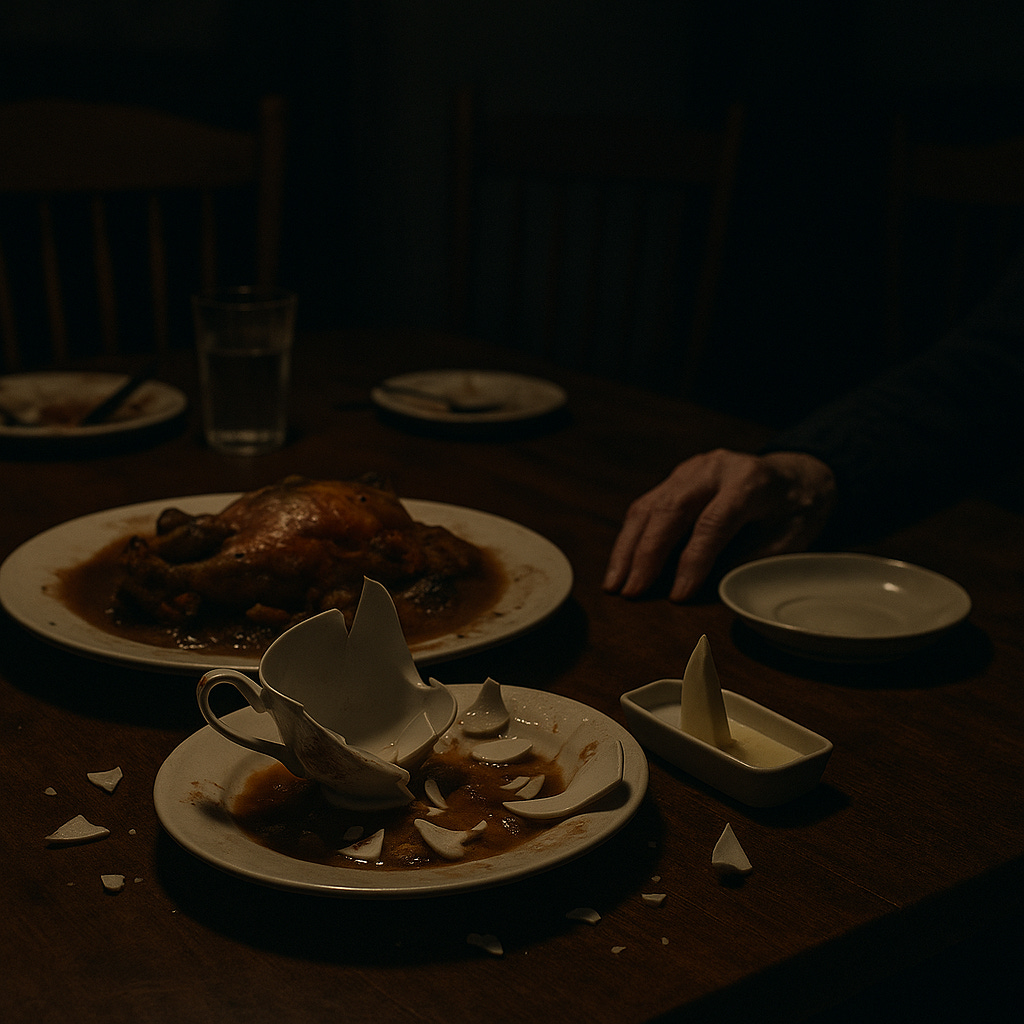
The husband stared down. The children froze, forks suspended. Her daughter’s hand gripped her teacup. She began to lift to her lips. Then her wrist turned. She brought the cup down hard. It smashed into porcelain fragments, skipping across the roast, sinking into the gravy, scattering across the tablecloth. One shard spun like a top until it stopped at Grandma’s plate. Another lodged upright in the butter dish, white as a spat-out tooth.
Her daughter shoved back her chair. “I’m finished,” she said.
She rose and walked out, gazing straight ahead of her. The husband followed, shoulders bent. The children trailed behind, squeaking their shoes on the hardwood floor. The sound of the front door slamming sealed the house closed.
Grandma sat alone. Her hand, still lifted, trembled in the air before she set the saucer on the tablecloth. The food was cold. The gravy had skinned over. The cup shards glistened in the lamplight. The butter softened around the porcelain tooth.
She listened for footsteps returning, for a voice to break the silence. The clock ticked like an indifferent metronome.
She kept staring at the fragments. Bitterness rose at the back of her mouth, sour and hot. Her mouth worked slowly and mindlessly, as though she might grind the shards into dust with her teeth and dentures.